Friday, July 23, 2010

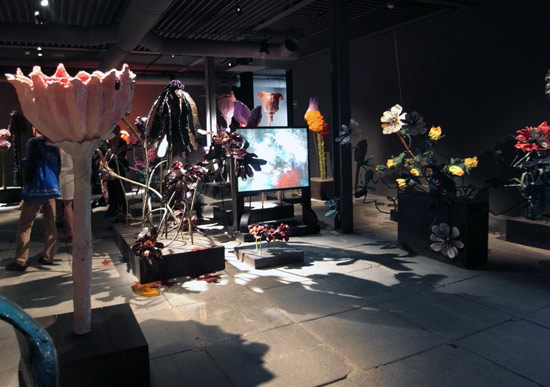
Nathalie Djurberg's 'Claymations'.


1. What do you understand by the word 'claymation'?

I have a slight idea to what the term 'claymation' means, but by looking at the word, i reckon its got to do with the moulding of clay into figures and taking photos of each and every movement it does. Kind of like a person who draws cartoons.

2. What is meant by the term 'surrealistic Garden of Eden'? and 'all that is natural goes awry'?
What i think what they mean by the term 'surrealistic Garden of Eden' by looking at the pictures, is that it has an 'exotic' feel to it due to the use of colours such as red along with the unusually shaped trees and plant life. In a way, it kind of makes you think 'Amazon' or some exotic jungle or something you get from a child's fiction book like 'Where the wild things are.' And for the term 'all that is natural goes arwy' what i think that they're trying to say is that the view of 'The Garden of Eden' is some what, different or even twisted to the point to make you think, 'Is the Garden of Eden really like this?'

3. What are the 'complexity of emotions' that Djurberg confronts us with?
The emotions Djurberg was trying confront us with is the feeling of fear of the unknown and the not understood.

4. How does Djurberg play with the ideas of children's stories, and innocence in some of her work?
How she plays with the ideas of children stories and innocence in her work is through the characters and figures used in the work. Figures such as a beast in comparison to a little girl with blonde hair something we all see in children's books from little red riding hood to the beauty and the beast.

5. There is a current fascination by some designers with turning the innocent and sweet into something disturbing. Why do you think this has come about?
I think this becoming a popular thing amongst some designers not only because they wanna do something different, but because it is easy for one who is sweet and innocent to change into one that is sour and sinful due to their pureness.


6. In your opinion, why do you think Djurberg's work is so interesting that it was chosen for the Venice Biennale?

The reason why i think the claymation work done by Djurberg was chosen for the Venice Biennale is because its different, it successfully put many points out there into one work, use of technology and skill and how it was interpreted in a way it makes you think whether the work was made for an audience that was for kids or for adults due to its cartoon-like nature to it.

The 'Claymation's' done by Djurberg is interesting on its own way, but by looking at the clay sculptures in comparison to the clay figures makes me think, "Clay sculptures - Looks like a prop used in a primary school play. Clay figures - Nostalgic feeling of cartoons such as Pingu."

Monday, May 17, 2010

Memorial Project Nha Trang, Vietnam- 'Towards the Complex-For the Courageous, the Curious and the Cowards


The 'Memorial Project Nha Trang Vietnam (2001)' is a video project done by Jun Nguyen-Hatsushiba. This video shows 3 cyclos getting pulled by two men for each cylco under the Nha Trang Bay. The reason why Jun wanted to make a video on something like this was to show the culture of the country slowly fading away into the modern western world. He used the cylcos as an example to show that this once prosperous way of transportation is now slowly fading into a tourist attraction and how it relates to the country slowly becoming more 'Westernized'.

It also features 30 mosquito nets which was set amongst the coral in the bay. What this symbolized a pilgrimage or a place of offering to the drivers of the cyclos. Jun also tells that the cyclo drivers or who carry people on their cyclos for a living would be pushed or put into a 'complex' situation of trying to find ends meet. Jun also says the nets should represent rest, repose, security, comfort, social and historical boundaries.

Ideas and concepts from the Enlightenment such as 'progress' can relate to this situation as it shows improvement of natural and social conditions of the people who get the benefit out of the fast growing technology of which most people adapt and use the benefits. But this also leaves out those who don't want to step out of their comfort zone and into the world of which developed so much in the past years or unable to keep up with a fast growing nation, in this case the cyclo drivers. This also makes you think if we were to look back just 10 years ago, what technology was available to the world in comparison to now. Also the view of Modernism with its idea of 'making human life more easier using machines' also plays its part here as it replaces cyclos with taxi's and buses as a means for better transport in the modern city.

What i think the title of the video 'Towards the Complex - For the Courageous, the Curious and the Cowards' relates to the artist's intentions to the art work is that it tells different points of view of which to look at the video. Complex; shows how complex life of a cyclo driver is through mosquito nets. Courageous; shows the cyclo drivers pulling their cyclos in the water. Curious; the cyclos plus the water equals something that would arouse your curiosity. Coward: for those who dared not to carry on the cultural lifestyle or avoid altogether.


References:
http://sites.asiasociety.org/arts/nh/interview.html
Hamilton,P(1992). The Enlightenment and the birth of social science, in Hall,S & Gieben B.(eds.) Formations of Modernity

Wednesday, April 28, 2010

Landscape and the Sublime

What and when was the Enlightenment?

Taking place during the 18th century centered in France, the Enlightenment was the creations of ideas about man, society and nature, which challenged existing conceptions rooted in a traditional world view, dominated by Christianity.

Define the concept of the Sublime.

The Sublime refers to something of greatness in very way which nothing can compare to and is beyond all possibilities

How did the concept of the Sublime come out of the Enlightenment thought?

Being not encouraged to add landscapes in paintings and drawings to the point they would discard it and leave it out in general, people saw the landscape as 'unimportant', until a statesman and political theorist Edmund Burke (1729-1797) and his beliefs of life of feeling and spirit depend on a harmony within the larger order of the universe, which made the sublime, the ultimate experience of divinity. He also saw this and the landscape 'connected'. This too was also encouraged by a writer called Wilhelm Wackenroder saying that "... there exists only two languages through which God allows the human to comprehend the Divine: one of these is reserve for God alone, but the other is given to a few "anointed favorites" who in turn interpret them." He also explained " the second language had components: "They are: nature and art." Through words like these, they encouraged artists such as David Friedrich and his work of the 'Cross in the Mountains'.

Discuss the subject matter, and aesthetic (look) of Misrach's work to identify the Sublime in his work.


Photos by Misrach such as the Pyramid Lake (Red & Yellow), Nevada (1991), which shows 3 small land masses and mountains from a distance on water which looks like it goes on forever, gives off a warm, tingly feeling you kind of get when you look at a great sunset but also a dark mysterious look as shadows and areas where light from the sun cant get them turn darker than before, a feeling which no human hasn't touched or tainted whereas the Playground and Shell Refinery, Norco, Louisiana (1998) photo has a deserted feel with the basketball court abandoned and left untouched with a power plant is in the background which shows the relationship between man and the environment.


Identify some other artists or designers that work with ideas around the Sublime, from the Enlightenment era as well as contemporary artists.


Joseph Mallord William Turner (1775-1851) and his painting of the "Fire at Sea" shows the early works during the rise of the Enlightenment of the idea around the Sublime. This painting shows a more power sense of feeling of what nature has and what we don't as humans as we see the ship get torn into pieces by the immense raw power of the waves.
Leon Chew and his photo of "The Architectural Landscape" which was a photo of Las Vegas taken from his hotel room which gives a feeling that there is a pot of dirt and greed dressed up in a nice lights and buildings to cover up the bad side of what happens there, which also relates to the saying "What happens in Vegas, Stays in Vegas". While sticking to the buildings, it also gives off another feeling and buzz of electric of unlimited things to do in the nightlife.


How does Misrach's photography make you feel? Does it appeal to your imagination?

Depending on what photos I was looking at, they gave me a feeling of 'Nostalgia' and makes you imagine to a point back in time that the certain area used to be inhabited by children or a place in your childhood that you used to like going and spending time there.


Reference:
Edmund Burke, A philospical Enquiry Into the Origings of our ideas of the Sublime and Beautiful,London, 1757, in Collected Works, T.W. Copeland, ed. London: 1865-1867
Wilhelm Wackenroder and Ludwig Tieck, Outpourings of ant-loving friar (Dresden, 1797). English ed. trans. by Edward Mornin. (New York: Grederick Ungar, 1975), p59. Wackenroder is the author of the essay "Of two Wonderful Languages and their mysterious power."

http://www.artnet.com/awc/richard-misrach.html
www.edelmangallery.com/misrach.htm
http://www.leonchew.co.uk/index.php?s=Architectural
http://www.en.utexas.edu/Classes/Moore/sublime/subPaint4.htm

Sunday, March 28, 2010

Damien Hirst


Damien Hirst, also known as the 'rock star' of the art world and is claimed to be the most richest artist living to date. He also specializes in a few fields in art such as conceptual art, installation art and painting. Through his many great artworks from sculptures to paintings and designs, he relates them mostly to his central theme of 'Death'. During the the 90s, his career was closely linked to Charles Saatchi of the Saatchi & Saatchi agency group, in which help with his rise to fame. He is also well known for being the mastermind behind making one of the most expensive artwork to make called 'For the Love of God' which is a platinum casted skull covered with 8601 flawless diamonds. Using the idea from the Aztec Turquoise, Hirst created out of what was originally an 18th century human skull, a diamond encrusted skull which weighed in at 1,106.18 carats. The only bit that still in tack from the original 18th century skull is the teeth which is also the only thing not to be covered with diamonds. Germaine Greer from the ' The Daily Telegraph' Newspaper said that [1]" Damien Hirst is a brand, because the art form of the 21st century is marketing. To develop so strong a brand on so conspicuously threadbare a rationale is hugely creative - revolutionary even."Being as he is, he has set the status of the artist to a whole new level as he approaches art in a way that makes you hate it or love it.


How Hirst's persona and his works relate to the Renaissance and concepts of mercantilism is that it shows how art is seen nowdays through his works, show a great example when both a changing point and an economic interest such as the diamonds put into a visual concept. It also shows that the bridge to from the 'Middle/Now Day and Age' to the 'Modern Age' is built through materialistic desires and continues to be built by materialistic world, which goes well with Hirst's theme of 'Death' because greed will be the death to all of those seeking more than they already have. His works also show a new form of how art is depicted which the Renaissance was about and how it could be seen by society as some form of 'celebrity' if one was an artist of some caliber and I believe will be a turning point of how art is made in the near future or taking the art perspective to a whole new level.


Reference:
http://en.wikipedia.org/wiki/For_the_Love_of_God
http://en.wikipedia.org/wiki/Damien_Hirst
Greer, Germaine (22 September 2008)." Germaine Greer to Robert Hughes: Bob dear, Damien Hirst is just one of many artists
you dont get "
The Guardian. http://www.guardian.co.uk/artanddesign/2008/sep/22/1. Retrieved 2010-01-01.
http://en.wikipedia.org/wiki/Renaissance
http://en.wikipedia.org/wiki/Mercantilism

Saturday, March 13, 2010

The Trienniel

What are the themes behind the title "Last ride..." for the Auckland triennial?

The themes behind the "last ride..." for the Auckland triennial are referred to a topic of interest by Natasha Conland, The curator of the triennial which is exploring the ongoing relationship between adventure and risk taking in contemporary art today .

The curator was also trying to achieve with the triennial was to create a sense of pathway by connecting the history of contemporary art across the city. The idea of the walk was to point out that the 'walk/travel/ to art is an important theme of which is examining what adventure means and characteristically what we aspire to when we think og adventure and later risks to the topic. She also talks about how mercantilism provides routes into adventure and exploration into the world of contemporary art. The themes this year are also more focused on Middle East/ East Asian and New Zealand contemporary art and how it varies to the 'Western' Art.

What does a curator of a exhibition do?

What a curator does is decide what art works are put up to relate to the theme. They would have a theme or topic in mind and both the curator and artists(s) work together to determine how the artist's art would be featured, displayed and organised. The curator are also in charge of looking after the artworks.


Which Countries are represented this year?

There are many countries that are represented in this year's trienniet such as Lebanon, China, France, Ireland, Germany, Australia, Thailand, Sweden, Argentina, Iran, Scotland, New Zealand, UK, USA, India and Denmark

Name 4 artists who will be showing work in the show

Laresa Kosloff, Gerard Byrne, Johana Billing and Jorge Macchi are just a few of the artists that are going to show their works in the show.

Is Auckland the only country to have a trienniel? Are there other similar art shows?

There are similar trienniels around the world such as Uk's Asian Trienniel of Contemporary Art and the Queensland Asia Pacific triennial of Contemporary Art, but none that compare to what the Auckland Trienniel has to offer.

This work done by Gerard Byrne called the 'Loch Ness' is a collection of pictures showing the myth and reality of the legend of the Loch Ness monster from films and photo shoots.


How i find this work of art interesting is of its layout working from 5 pictures on the left hand side and slowly works to only the one picture in the end on the right hand side. It also kind of tells a story which starts from the first sightings of the Loch Ness Monster and the Loch itself and then the last picture which shows what seems to be a mysterious future sighting of the Loch Ness Monster. I also like the black and white theme which gives an old and mysterious feel amongst the works. How it relates to my own interest is that I like it when photos are taken in black and white and how the photos tell a story, something that I would like to do in my own works if I ever get the chance to and someting I try to do when im painting.